
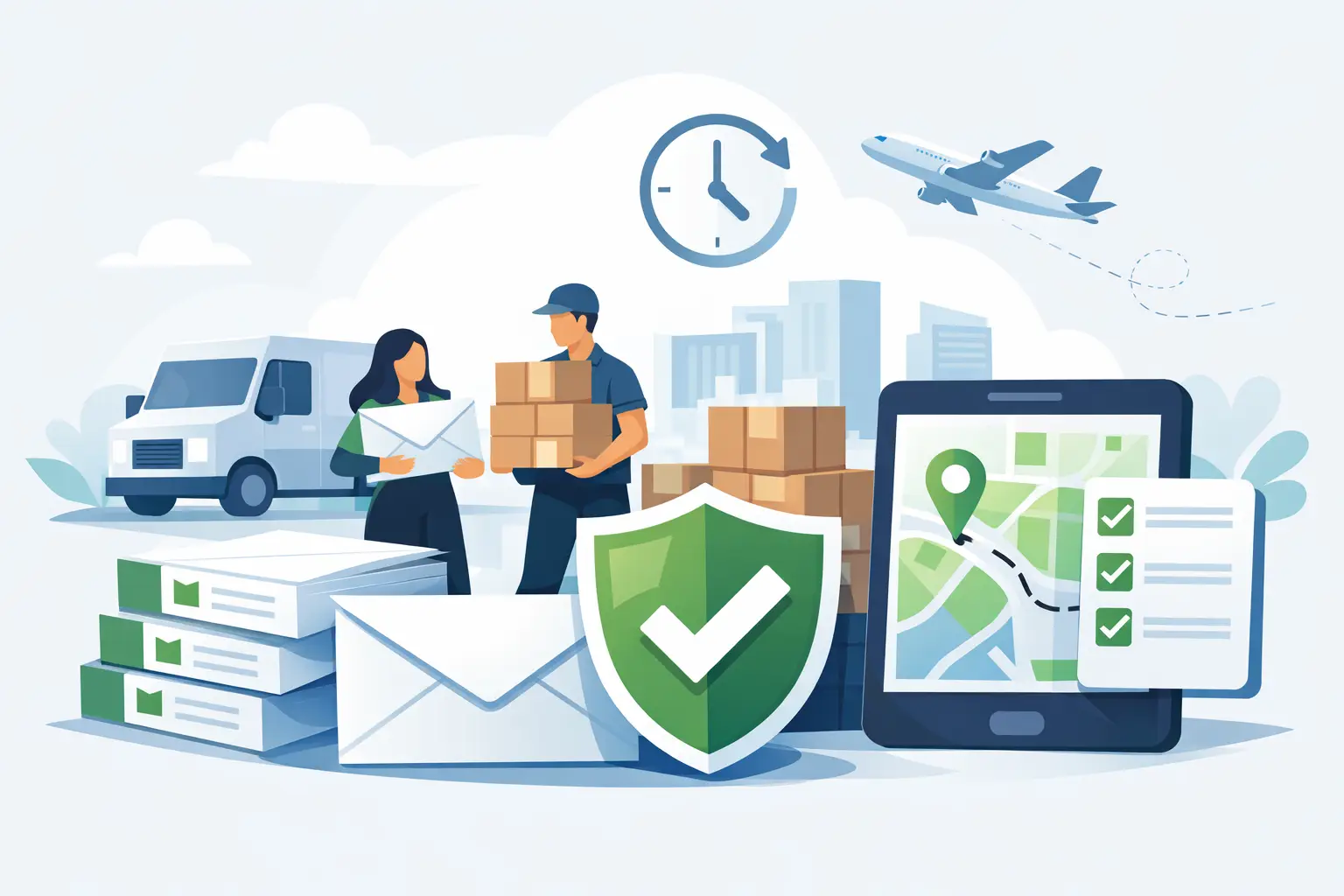
 When a foreclosure notice, collections letter, utility shutoff warning, or legal demand has to go out on time, the problem usually is not printing the letter. The problem is everything that happens after. A bulk Certified Mail service exists to take that operational burden off internal staff while preserving the USPS documentation and tracking needed for compliance.
For organizations that send high volumes of time-sensitive notices, the question is not whether Certified Mail works. It does. The real question is whether your internal process can keep up without creating missed deadlines, inconsistent records, or unnecessary labor costs. That is where bulk processing changes the equation.
What a Bulk Certified Mail Service Actually Does
At a basic level, a bulk Certified Mail service handles the production and submission steps that would otherwise happen in-house. Instead of printing letters, matching pages, folding documents, stuffing envelopes, applying certified forms, and waiting at the post office, teams submit files and recipient data through a centralized workflow. The service then prints, addresses, and mails each piece using USPS services, while preserving the mailing records tied to each notice.
That distinction matters. This is not just outsourced printing. For compliance-driven organizations, the value is in maintaining defensible proof that a specific document was mailed to a specific recipient on a specific date, with USPS acceptance and downstream tracking available for review.
In practice, that means a bulk service should support the full chain of evidence: document submission, mailing date, USPS acceptance, in-transit tracking, delivery confirmation, and archived records that can be retrieved later if a file is audited or challenged.
Why Manual Certified Mail Breaks Down at Volume
Most organizations do not feel the pain of manual Certified Mail when they send five pieces a week. They feel it when volume spikes, deadlines tighten, or documentation gets questioned months later.
A legal office may have a filing deadline tied to notice requirements. A property manager may need to send dozens of notices at once across multiple properties. A collections team may have recurring notice batches that must go out on schedule and be documented consistently. In those environments, manual processing creates avoidable risk.
The first issue is labor. Certified Mail is not a single task. It is a chain of small tasks, and each one introduces the chance for error. The wrong address can be paired with the wrong letter. A mailing receipt can be misplaced. Tracking numbers can be entered incorrectly. Staff time that should be spent on legal review, case management, or customer service ends up being used on repetitive mail preparation.
The second issue is recordkeeping. A green card, a retail receipt, or a spreadsheet maintained by hand may be enough for a small office, but it does not scale well. Once volume increases, fragmented records become a real problem. If someone asks for proof of mailing from eight months ago, you need more than a best guess.
The third issue is process consistency. Different employees handle mail differently. Some double-check addresses. Some do not. Some retain receipts carefully. Some do not. A bulk Certified Mail service standardizes that workflow so the process is less dependent on individual habits.
Where the Compliance Value Comes From
The strongest reason to use a bulk Certified Mail service is not convenience alone. It is procedural control.
For regulated or legally significant mail, proof matters at several levels. You may need proof that the item entered the mailstream on time. You may need USPS acceptance records. You may need tracking that shows movement through the system. In some cases, you may also need Electronic Delivery Confirmation or signature-based Return Receipt options.
That layered documentation is what gives Certified Mail its value in compliance workflows. It does not guarantee a recipient will cooperate, and it does not replace legal advice about service requirements. But it does create a documented mailing trail that is far stronger than ordinary office mail.
This is especially useful for organizations facing internal audits, regulator inquiries, disputes over notice timing, or litigation support requests. A process that produces consistent, retrievable records is easier to defend than one built around manual receipts and local post office visits.
What to Look for in a Bulk Certified Mail Service
Not every provider handles compliance mail with the same level of discipline. If your notices carry legal, financial, or regulatory consequences, the service needs to do more than generate postage.
Start with submission workflow. A useful platform should let teams upload PDFs, submit recipient data cleanly, and process jobs without rebuilding the mail package by hand. If your volume is recurring or system-driven, API or SFTP support may matter just as much as a web portal.
Next, look at production timing. Same-business-day mailing can be a significant control point for deadline-driven notices. If your process depends on cutoff times, internal approvals, or statutory windows, turnaround is not just a convenience feature.
Tracking and reporting are equally important. You should be able to identify what was mailed, when it was accepted by USPS, how it moved through the system, and whether delivery was completed. If that information is difficult to export or reconcile, the service will create work instead of removing it.
Record retention deserves close attention. Many teams do not think about archival access until they need to respond to a dispute or audit. A provider that retains mailing records over the long term can reduce both legal exposure and administrative effort.
Bulk Certified Mail Service vs. Doing It In-House
There are cases where in-house mailing still makes sense. If an office sends a very small number of certified items each month, has trained staff available, and does not need centralized reporting, internal handling may be sufficient.
But once mailing volume becomes recurring, multi-user, or deadline-sensitive, in-house processing usually costs more than it appears to. The hidden cost is not just postage supplies or labor hours. It is interruption, exception handling, and rework. Every batch requires coordination. Every urgent mailing disrupts someone’s day. Every documentation gap creates future cleanup.
A bulk Certified Mail service shifts that work into a repeatable process. It also reduces dependence on individual employees to maintain mailing accuracy and retention discipline. For larger organizations, that operational consistency is often more valuable than the direct labor savings.
Bulk Certified Mail Service for Recurring Notice Programs
The best fit for bulk processing is recurring notice activity. That includes monthly demand letters, default notices, collections communications, compliance notifications, hearing notices, tax mailings, code enforcement letters, and other formal correspondence sent in predictable cycles.
In these programs, scale is only part of the issue. Repeatability is the bigger concern. You want each mailing cycle to follow the same documented path so reporting is consistent from one batch to the next.
This is where workflow-oriented platforms stand apart from generic mail houses. A compliance mailing platform should not only produce the mail but also support the administrative side of the job: recipient imports, batch controls, mailing reports, tracking visibility, and retained proof of submission and delivery events. Send Certified Mail is built around that operating model, which is why it fits organizations that need mailing records to stand up well after the envelopes are sent.
Trade-Offs Worth Considering
Certified Mail is not the right choice for every document. Some notices may only require First-Class Mail with proof of mailing, such as a Certificate of Mailing. Others may justify Priority or Express services because speed matters more than standard certified tracking. The right mailing class depends on legal requirements, risk tolerance, and budget.
There is also a balance between automation and review. Fully automated submission can speed up recurring mail dramatically, but many teams still need approval checkpoints for sensitive documents. A good bulk service should support operational efficiency without forcing you to give up internal controls.
And while outsourcing mailing reduces manual handling, it does not eliminate the need for clean source data. If recipient addresses are wrong or documents are uploaded incorrectly, the mailing process can only work with what it receives. Strong internal data hygiene still matters.
The Operational Standard to Aim For
A reliable bulk Certified Mail service should make your mailroom less relevant, not more busy. Staff should be able to submit files, confirm mailing activity, monitor USPS tracking, and retrieve records without piecing together evidence from multiple systems and paper receipts.
That kind of process control matters because compliance mail is rarely judged by intent. It is judged by documentation, timing, and consistency. When those elements are built into the mailing workflow, organizations are in a stronger position to meet deadlines, answer audits, and reduce avoidable disputes.
If your team is still treating Certified Mail as a manual office task, it may be time to look at it as what it really is: a records-driven business process that deserves the same discipline as any other compliance function.