
 A missed notice deadline can create a legal problem faster than most teams expect. That is why a common operational question is, how does USPS Certified Mail work when you need documented proof that a letter was mailed, tracked, and delivered or delivery was attempted.
USPS Certified Mail is an extra service added to First-Class Mail or Priority Mail that creates a mailing record and assigns a tracking number. It is designed for senders who need evidence that an item entered the mailstream and visibility into its delivery status. For law firms, property managers, collection agencies, insurers, utilities, and government offices, that documentation often matters as much as the letter itself.
How Does USPS Certified Mail Work in Practice?
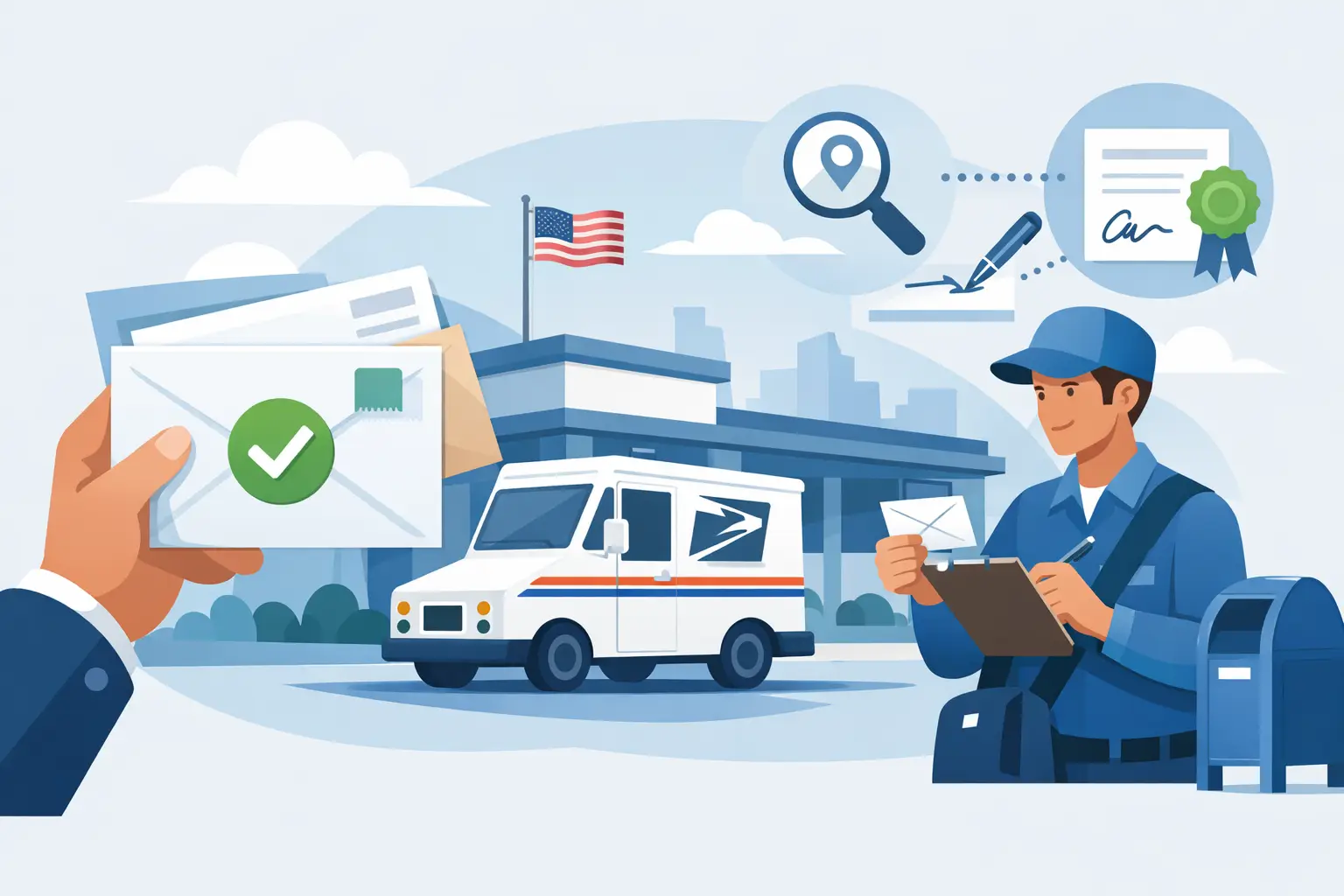
At the most basic level, Certified Mail starts with a mailpiece that is prepared with USPS Certified Mail service attached. Once USPS accepts the item, it receives a tracking record. As the piece moves through the mailstream, the sender can monitor scans that show progress toward delivery. If the sender adds Return Receipt service, they can also obtain recipient signature information or electronic proof associated with delivery.
That sounds simple, but the operational value comes from the paper trail. Certified Mail gives the sender proof of mailing, a unique tracking number, and delivery status information. In compliance-driven environments, those three elements support internal controls, deadline management, and dispute response.
The service does not mean the letter moves like overnight mail, and it does not guarantee actual receipt by the intended person in every case. It provides documented handling through USPS, with optional services that strengthen the record.
What Happens from Preparation to Delivery
The workflow begins before the envelope enters the mailstream. The sender prepares the letter, confirms the recipient address, and applies Certified Mail service. In manual office settings, that may involve USPS forms, labels, and a trip to the post office. In higher-volume operations, businesses often use print-and-mail workflows that generate the mailpiece, apply the certified tracking, and submit it for USPS processing without handling each envelope in-house.
Once USPS accepts the item, the sender has evidence that the piece was mailed. That acceptance event matters in regulated mail because many deadlines are tied to mailing date, not just delivery date.
As the item travels, USPS tracking scans update its status. Those scans may show acceptance, transit, out for delivery, delivered, or attempted delivery. If no one is available to receive the item when a signature-related service applies, USPS may leave a notice and attempt redelivery or hold the item for pickup, depending on the circumstances.
Delivery is the final step, but from a records perspective, the real endpoint is the documentation. Businesses usually need to retain the mailing proof, tracking history, and any signature or Return Receipt data together. That is what makes the mailing defensible later.
What Proof Does Certified Mail Provide?
Certified Mail is used because standard stamped mail usually leaves gaps in the record. With regular mail, you may know what you sent internally, but you may not have independent USPS documentation showing acceptance and delivery activity.
Certified Mail fills that gap with several forms of evidence. The first is proof that USPS accepted the item into the mailstream. The second is tracking visibility as the piece moves through processing and delivery. The third, when selected, is Return Receipt information that ties delivery to a signature record or electronic delivery confirmation.
For organizations managing notices of default, demand letters, adverse action notices, tax communications, claim correspondence, or tenant notices, that evidence can support audits, hearings, disputes, and internal compliance reviews.
What It Does Not Do
Certified Mail is often misunderstood. It does not automatically provide a copy of the signed green card unless Return Receipt is added. It is also not the same as Registered Mail, which is a different service with a higher-security chain of custody for valuable items.
It also does not eliminate bad address risk. If the address is incorrect, outdated, or incomplete, the letter can be delayed, returned, or remain undeliverable despite proper mailing. Certified Mail documents the process, but it cannot fix address quality problems on its own.
Certified Mail Options That Affect the Record
The basic Certified Mail service provides mailing evidence and tracking. Many organizations add services depending on their legal or operational requirements.
Return Receipt is the option most people associate with a signature record. It can be provided in physical or electronic form, depending on how the mail is prepared and what the sender needs for retention. Electronic Return Receipt is often easier for organizations that want searchable records and centralized storage.
Signature-related services may also be relevant when the sender needs stronger delivery documentation. The right option depends on the notice type, internal policy, and any governing regulation or contract language.
There is a trade-off here. Adding services improves documentation, but it also increases cost and can affect handling. Not every compliance letter requires the most expensive configuration. Many organizations standardize by notice type so staff are not making case-by-case mailing decisions under deadline pressure.
Delivery Timing and Expectations
Certified Mail does not operate as an expedited class by itself. The speed is tied to the underlying mail class, usually First-Class Mail or Priority Mail. In other words, certified status adds documentation and tracking, not guaranteed fast delivery.
For time-sensitive notices, this distinction matters. If a deadline is tight, the sender should evaluate whether First-Class with Certified Mail is sufficient or whether a faster mailing class is more appropriate. Compliance teams often build this decision into workflow rules rather than leaving it to last-minute judgment.
USPS delivery timing can also vary by destination, weather, local processing conditions, and recipient availability. That is why organizations with strict notice schedules generally mail early enough to account for normal variation.
Why Businesses Use Certified Mail for Compliance Work
The question is not only how does USPS Certified Mail work, but why it remains common in formal business correspondence. The answer is simple: it creates an auditable trail using a recognized USPS process.
That matters when a business needs to show that a notice was mailed on time, sent to a specific address, and tracked through delivery or attempted delivery. It also matters when internal teams need one repeatable process instead of a patchwork of manual steps, paper receipts, and individual post office visits.
In lower volume settings, manual Certified Mail may be manageable. In recurring, deadline-driven environments, it often becomes an administrative burden. Staff have to print letters, assemble mailpieces, apply forms, track receipts, monitor delivery, and store records. The process works, but it does not scale well.
That is why many organizations shift Certified Mail into a managed workflow. Platforms such as SendCertifiedMail.com allow teams to upload PDF letters, submit recipient data, have pieces printed and mailed the same business day, and retain tracking and proof records in one system. For organizations balancing compliance obligations with labor constraints, the operational benefit is not just convenience. It is process control.
Common Issues and Where Mistakes Happen
Most Certified Mail problems are not caused by USPS service failure. They happen earlier, during preparation and record management.
The most common issue is bad recipient data. If the address is wrong, the documentation may still show proper mailing, but the business outcome can still be a failed notice. Another issue is inconsistent service selection. One department may use Return Receipt, another may skip it, and later no one can explain the difference. Record retention is another weak point. If receipts, tracking screenshots, and signed confirmations live in separate places, the mail was documented but not managed.
There is also the timing issue. Teams sometimes assume Certified Mail is a fast service and send too close to a statutory deadline. That is a planning mistake, not a mailing mistake.
The strongest programs reduce these risks by standardizing mail classes, confirmation options, approval rules, and retention practices. When the process is consistent, the records are easier to trust.
When Certified Mail is the Right Fit
Certified Mail is a strong choice when you need USPS proof of mailing, delivery tracking, and a documented trail for formal correspondence. It is commonly used for notices where the sender may later need to demonstrate that the item was sent and monitored through delivery.
It may be less appropriate when speed is the top priority, when the item has unusually high monetary value, or when another delivery channel is specifically required by law, contract, or court rule. The mailing method should match the obligation.
A practical standard is this: if the cost of not being able to prove mailing is higher than the added service cost, Certified Mail is usually worth serious consideration.
For organizations with recurring notice volume, the bigger question is not whether Certified Mail works. It does. The better question is whether your current process gives you the same level of control over preparation, tracking, and retention as the USPS documentation itself.