
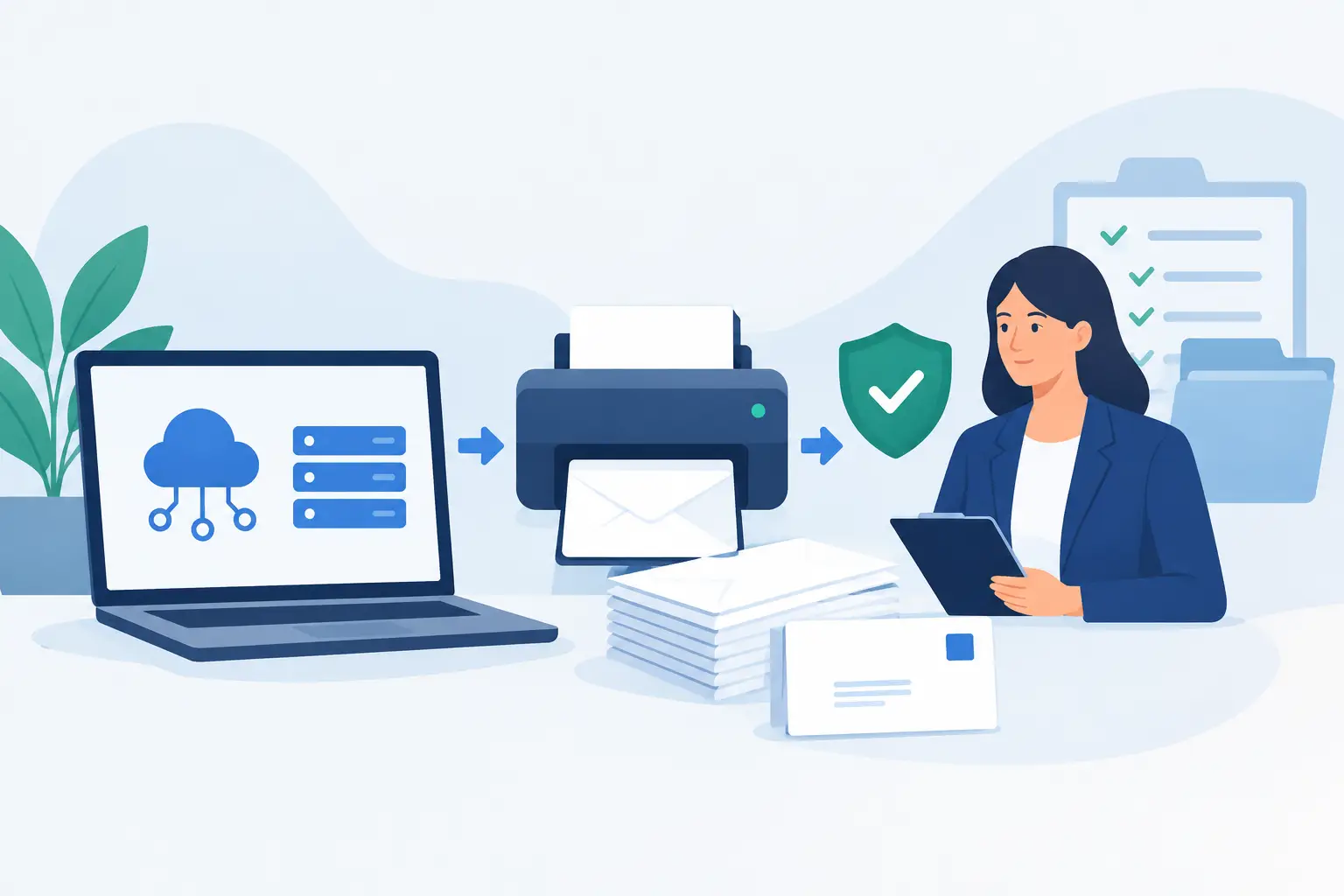
 A compliance notice is only as defensible as the process behind it. If a deadline-sensitive letter sits in a local print queue, waits for an employee to stuff envelopes, or relies on a post office receipt that is later misplaced, the organization has created avoidable exposure. API driven print mailing replaces those disconnected steps with a controlled submission and documentation workflow.
For organizations that issue recurring legal, regulatory, financial, or operational notices, the value is not merely sending mail faster. It is creating a repeatable process that connects the business system that generates the notice with physical USPS mailing, tracking, and retained records. That distinction matters when an auditor, customer, court, regulator, or internal stakeholder needs to know exactly what happened and when.
What API Driven Print Mailing Does
API driven print mailing uses an application programming interface to send mailing instructions from one software system to a print-and-mail platform. Rather than having staff download a letter, print it locally, prepare an envelope, apply postage, and visit a post office, a business application can submit a PDF and recipient data directly to a mailing workflow.
The mailing platform then prints the document, addresses the envelope, applies the selected USPS mailing service, and enters the item into the mailstream. For Certified Mail, the workflow can also capture USPS acceptance, in-route tracking, Electronic Delivery Confirmation, and optional Return Receipt Signature confirmation. Records are retained so the mailing activity can be retrieved later without relying on an individual employee's files or memory.
This approach is especially useful when the source document already originates in a case management system, property management platform, collections application, customer communications system, or internal compliance database. The organization does not need to rebuild a process around manual mail preparation each time a notice is generated.
Why Manual Certified Mail Workflows Create Risk
Manual mailing can work for a handful of letters. It becomes harder to control when volume grows, staff changes, or notices must leave on a defined date. The problem is rarely one task in isolation. It is the number of handoffs: generating the letter, validating the address, printing the final version, selecting the mail class, preparing the envelope, obtaining USPS acceptance, capturing tracking information, and filing the evidence.
Each handoff presents an opportunity for an error. A letter may be mailed a day late. A recipient address may be copied incorrectly. A proof-of-mailing document may be stored in an inbox no one can access later. Tracking numbers may be entered into a spreadsheet inconsistently, making status reporting incomplete.
API integration does not eliminate the need for sound internal controls. The organization still needs correct data, approved letter templates, authority rules, and a process for handling exceptions. It does, however, reduce the number of manual actions between the approved notice and the USPS mailing record. That reduction improves consistency and makes the process easier to review.
The Operational Difference Is Timing and Evidence
For many compliance teams, the critical question is not whether a letter was eventually printed. It is whether the organization can establish the mailing date, the service used, the recipient address, and the delivery outcome when needed.
A properly configured API workflow can submit a mailing request at the point a notice is finalized. The request can include a unique internal reference number, recipient information, mailing class, and document file. Once processed, the mailing record can be associated with the originating case, account, property, claim, or customer record.
That association is valuable because it keeps the document and its mailing evidence connected. Staff do not have to search a separate filing cabinet, shared drive, or spreadsheet to determine whether a particular notice was sent. They can work from the business record that initiated the mailing.
A Practical API Mailing Workflow
The best implementation starts with the existing process, not the technology. Identify the event that creates the mailing obligation. For a property manager, it might be a lease violation or delinquency event. For a law firm, it might be a demand letter or case-related notice. For a utility or government office, it may be a required customer notification generated by a scheduled workflow.
The application then produces the approved PDF and sends it with structured recipient data through the API. A reliable request should include enough information to identify the mailing internally, even years later. That commonly means an account or matter number, a document type, the date generated, and a recipient or location identifier.
After submission, the mailing service processes the request according to the selected delivery method. Same-business-day print-and-mail processing can be particularly important for deadline-driven correspondence, provided the submission is made within the applicable processing window. The platform returns a mailing identifier and, where applicable, USPS tracking information that can be stored in the originating system.
From there, status reporting can be automated. A team may use status updates to identify delivered notices, follow up on exceptions, respond to customer inquiries, or document the record for a legal file. The design should account for the fact that physical mail has variable transit times. Automation improves submission and visibility, but it does not make delivery dates guaranteed.
Choosing the Right Mailing Evidence
Not every formal letter requires the same USPS service. Selecting the service should be based on the governing requirement, the organization’s risk policy, the value of the matter, and the type of evidence needed.
USPS Certified Mail is commonly used when the sender needs documented acceptance and delivery-related tracking for significant notices. Electronic delivery confirmation provides a recorded delivery status, while Return Receipt Signature confirmation may be appropriate when a signature record is required or operationally valuable. A Certificate of Mailing may be suitable when the requirement is proof that the item was presented to USPS, rather than proof of delivery.
First-Class Mail, Priority Mail, and Priority Express Mail can also have a place in a compliance mailing program, depending on urgency and documentation requirements. More expensive service is not automatically better evidence. The key is matching the mail class and confirmation option to the obligation at hand, then applying that choice consistently.
A mature workflow should make those decisions deliberate. Rather than leaving service selection to whoever happens to prepare the envelope, the organization can use rules based on notice type, jurisdiction, account status, or internal approval requirements.
Implementation Controls That Matter
An API connection should be treated as part of the organization’s compliance process. The technical connection may be straightforward, but the surrounding controls determine whether it produces dependable records.
Start by using stable internal reference numbers. If a mailing record cannot be tied back to a matter, account, or document version, it is far less useful during an audit or dispute. Validate addresses before submission where possible, and define what happens when an address is incomplete, rejected, or changed after the notice is generated.
Document version control matters as well. The PDF submitted for mailing should be the final approved communication, not a draft that could later differ from the version in the case file. Organizations with high-volume or sensitive correspondence should also establish access controls so only authorized systems and users can trigger mailings or change delivery instructions.
Exception handling deserves equal attention. Determine who reviews failed submissions, returned or undeliverable mail, tracking anomalies, and duplicate requests. An automated workflow should surface exceptions quickly rather than silently marking every submission as complete.
Finally, decide how long mailing records must remain available. For many audit-sensitive programs, retaining the submitted document, recipient data, USPS acceptance information, tracking events, confirmation records, and internal reference number together is more useful than retaining only a tracking number. Send Certified Mail maintains records for up to 10 years, supporting organizations that need long-term access to mailing documentation.
When an API Is the Right Fit
API driven print mailing is most valuable when mail is recurring, time-sensitive, or generated by a business system. It is a practical fit for legal operations teams sending demand notices, property managers issuing required correspondence, collection agencies managing account notices, and government or utility offices distributing regulated communications.
It may be unnecessary for a small office that sends a few nonrecurring letters each month and has no system from which to automate them. In that case, a secure online upload workflow may provide the needed control without development work. Similarly, an organization with highly variable documents may begin with manual review before moving to full automation.
The goal is not automation for its own sake. The goal is a mailing process that can reliably prove what was sent, when it entered USPS custody, and what happened afterward. When that evidence is connected to the record that created the obligation, compliance mail becomes easier to manage and far easier to defend.