
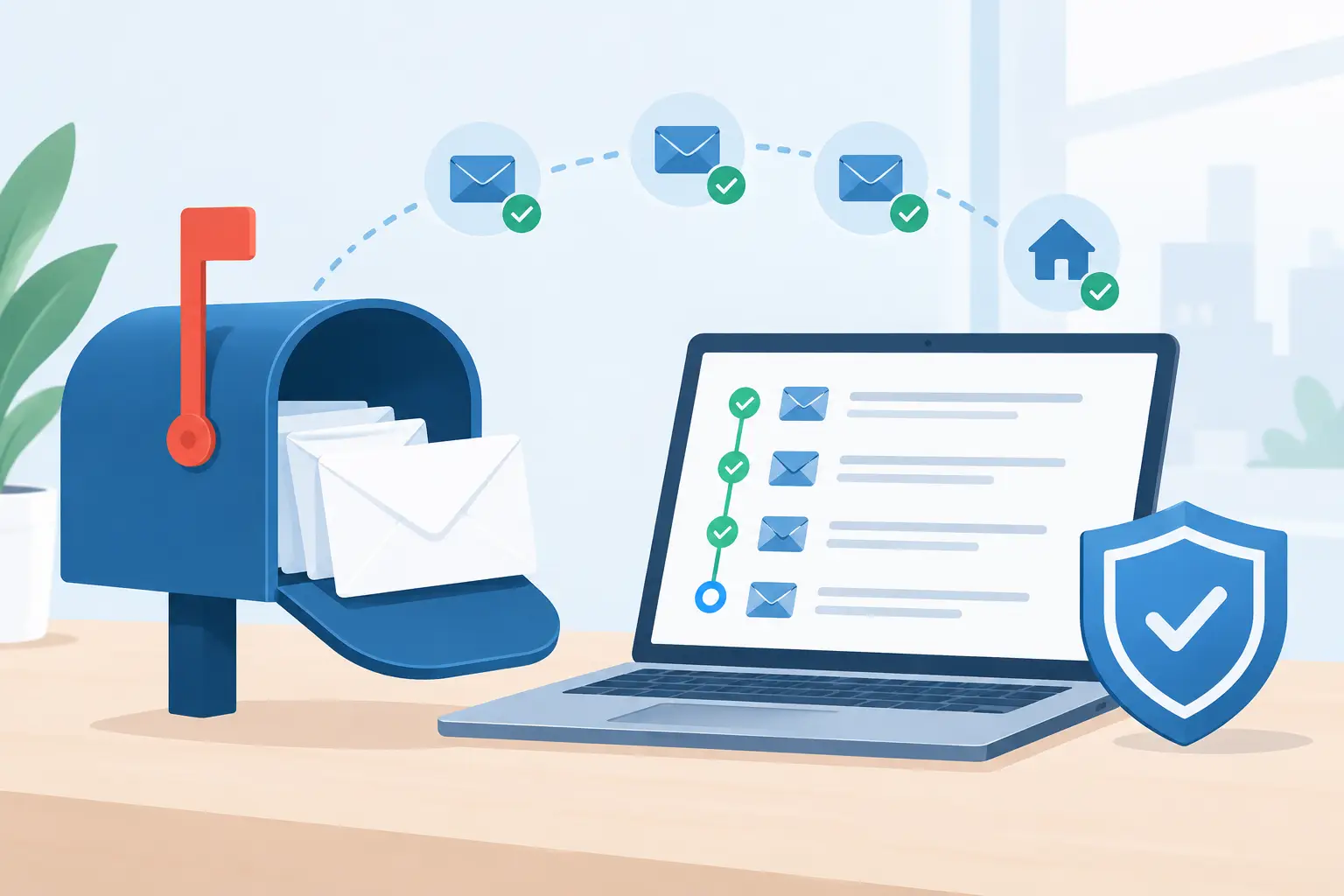
 A missed tracking event can create more than an administrative inconvenience. For a legal notice, collection communication, utility shutoff letter, code enforcement notice, or insurance correspondence, it can leave the organization unable to demonstrate what happened after the document left the office. Compliance letter tracking closes that gap by connecting the letter, recipient, USPS mailing event, tracking history, and delivery evidence in one documented process.
For organizations that send deadline-driven correspondence, the objective is not simply to know whether a letter arrived. The objective is to maintain defensible proof that the correct document was mailed to the correct recipient through a controlled process, with records available when a customer, regulator, auditor, attorney, or internal reviewer asks for them.
What Compliance Letter Tracking Should Document
A mailing status alone is rarely enough for a compliance-sensitive workflow. Teams need a record that can be matched to the underlying case, account, property, claim, or file number. That record should show the date the letter was submitted, the mailing class selected, the recipient address used, and the USPS acceptance event.
For Certified Mail, in-route tracking and Electronic Delivery Confirmation provide visibility after acceptance. When signature confirmation is needed, a Return Receipt option can add evidence of the person who received the item. For letters where proof of mailing is the central requirement, a Certificate of Mail or other documented first-class mailing workflow may be appropriate.
The right evidence depends on the notice and the governing requirement. A landlord sending a statutory notice, for example, may have different obligations than a law firm mailing a demand letter or an insurance team issuing time-sensitive claim correspondence. Tracking should support the applicable process rather than become a one-size-fits-all substitute for reviewing notice rules.
Why a Mailing Receipt Is Not a Complete Workflow
Many organizations still prepare critical mail manually. An employee prints a letter, stuffs an envelope, applies postage, visits the post office, and saves a receipt. This can work at low volume, but it creates process weaknesses as volume, staff turnover, and audit demands increase.
Receipts may be stored separately from the letter that generated them. Tracking numbers may be copied into spreadsheets with transcription errors. Delivery information may be checked once but not retained with the case file. If a team member is absent, another employee may have difficulty locating the documentation needed to respond to a dispute.
A controlled compliance letter tracking process treats mail as a business record, not an isolated task. The document, recipient data, mailing proof, tracking status, and confirmation details should remain associated throughout the record lifecycle. That approach reduces time spent reconstructing events months or years later.
Build the Process Around the Letter Before It Is Mailed
Tracking starts before USPS acceptance. If the underlying document and address data are not controlled, a delivery scan cannot fix the problem. Organizations should establish a repeatable submission process that identifies the correct version of the letter, validates recipient information, assigns the appropriate mailing service, and attaches a meaningful internal reference number.
For recurring notices, templates and case-management rules help maintain consistency. The same file or account identifier should appear in the source system, the mailing submission, and the reporting record. This makes it possible to retrieve evidence without relying on an employee's memory or searching through disconnected folders.
A practical workflow generally follows this sequence:
- Finalize the PDF letter and confirm the recipient address.
- Assign the mailing method based on the notice requirement and business policy.
- Submit the document with a case, account, property, or matter reference.
- Capture USPS acceptance and tracking details as part of the mailing record.
- Monitor exceptions, retain delivery evidence, and document follow-up action when needed.
The benefit is procedural clarity. Each step answers a specific question: What was mailed? To whom? When was it accepted? What happened in transit? What did the organization do when delivery was delayed, refused, or unsuccessful?
Match the Mailing Method to the Compliance Requirement
Certified Mail is often selected when the sender needs documented USPS acceptance, tracking, and delivery confirmation. It can be a sound choice for formal correspondence where the organization wants a visible chain of custody and proof that the item entered the postal system.
However, Certified Mail is not automatically required for every compliance letter. Some statutes, contracts, agency rules, or internal policies require first-class mail, while others require a particular combination of regular mail and a tracked method. In other cases, proof of mailing matters more than recipient signature. The mailing method should be determined by legal counsel, the governing rule, and documented organizational policy.
This is where operational discipline matters. Teams should avoid choosing a service based only on habit or the perceived seriousness of a letter. A more expensive service does not correct an incorrect address, an outdated template, or a missed deadline. The strongest process combines the right service with accurate data, timely submission, and reliable retention.
Use Exception Management, Not Just Delivery Updates
Delivery confirmation is valuable, but the most useful operational information often comes from exceptions. An item may be delayed, forwarded, held for pickup, refused, returned, or marked undeliverable. These events can affect a deadline, trigger a required second notice, or reveal that customer data needs correction.
A mature tracking process assigns ownership for reviewing these events. For some organizations, a daily exception report is appropriate. For others, staff may work from a queue that flags items requiring action. The key is to define what happens next. A returned letter should not sit in a report without a documented decision.
For example, a property management company may need to verify an alternate address or post a notice after a mailed item is returned. A collection operation may need to update its account notes and follow defined communication rules. A government office may need to preserve the returned envelope or document a second mailing attempt. Tracking data is most valuable when it drives a consistent response.
Make Records Available for the Long Term
The need for mailing evidence often arises long after the letter was sent. A dispute may surface during litigation, an audit may examine historical files, or a customer may challenge whether notice was provided. If documentation is scattered across local drives, paper files, email inboxes, and postal receipts, retrieval becomes slow and uncertain.
Retention should reflect the organization's legal, regulatory, contractual, and internal recordkeeping requirements. The record should preserve enough context to be understood on its own: the mailing date, recipient, address, tracking number where applicable, service used, USPS acceptance information, delivery status, and the related document or document identifier.
Send Certified Mail supports this recordkeeping model by allowing organizations to upload PDF letters, submit recipient data, have critical mail printed and mailed the same business day, and retain mailing and tracking records for up to 10 years. For teams handling recurring notices, this replaces fragmented handoffs with a documented operational trail.
Automate High-Volume Compliance Mail Carefully
Manual entry may be workable for occasional letters, but it introduces risk when notices are sent at scale. API and SFTP integrations can move approved documents and recipient data from a case management, billing, collections, property management, or enterprise system into the mailing workflow without repeated rekeying.
Automation does not eliminate the need for controls. It changes where those controls should sit. Teams should validate file formats, required fields, address logic, job-level approval rules, and error handling before production deployment. They should also determine how the mailing system returns tracking data and how that data is associated with the originating record.
A phased implementation is often sensible. Start with one notice type, confirm that reports and exception handling meet operational needs, then expand. This approach is slower than turning on every workflow at once, but it reduces the chance that a configuration mistake affects a large batch of regulated correspondence.
Questions to Ask When Reviewing Your Process
A useful review is not limited to asking whether letters are delivered. Ask whether your team can retrieve the exact document mailed for a specific matter, prove the USPS acceptance date, identify unresolved exceptions, and produce a coherent record without manual reconstruction.
Also consider continuity. If the employee who handles mail is unavailable, can another authorized person send notices and locate prior evidence? If monthly volume doubles, does the process remain accurate? If an auditor requests a sample from three years ago, can the organization respond promptly?
The answers reveal whether tracking is functioning as a true compliance control or merely as a collection of postal updates. The strongest workflows make the right action easier for staff while preserving the evidence the organization may need later.
A well-managed letter should leave behind more than a tracking number. It should leave a clear, retrievable record that supports the decision to mail, the deadline that required it, and the proof that the organization followed through.