
 A notice can be mailed on time and still create a compliance problem if the organization cannot later show when USPS accepted it, where it went, and what delivery evidence is available. That is why priority mail versus first class is more than a postage question for legal, regulatory, and deadline-driven correspondence. The right choice depends on the document, the deadline, the required level of proof, and the process your team can support consistently.
For routine business notices, First-Class Mail is often the practical baseline. Priority Mail may be appropriate when transit speed, package size, or a more visible service level matters. Neither service, by itself, replaces the documentation features needed for many formal notices. Mailing class and mailing evidence should be evaluated separately.
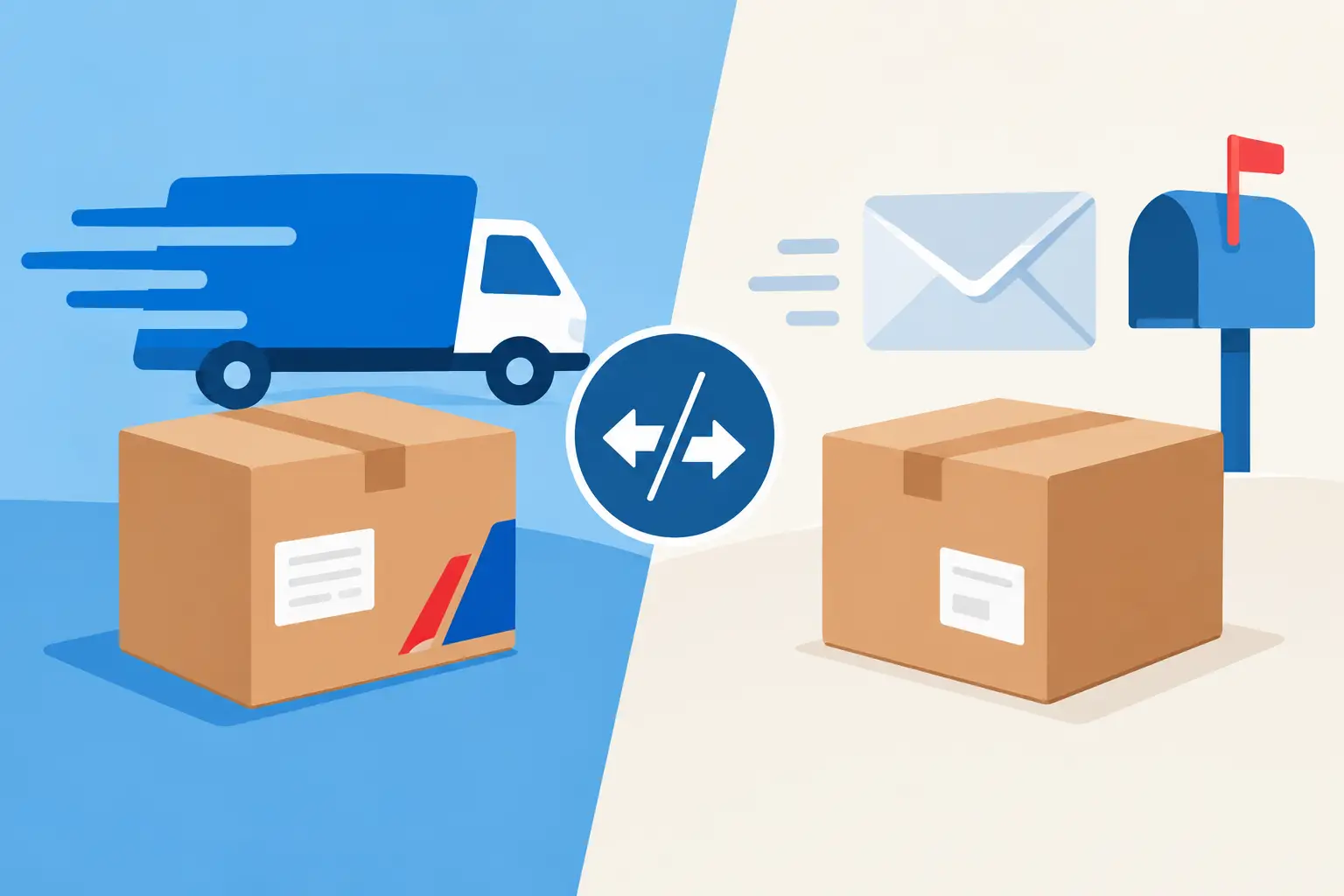
Priority Mail Versus First Class: The Core Difference
First-Class Mail is designed for letters, large envelopes, and other lightweight correspondence. It is commonly used for notices, statements, demand letters, compliance communications, and other documents that need reliable USPS handling without the cost of an expedited service. USPS delivery estimates for First-Class Mail are generally one to five business days, though estimates are not guarantees.
Priority Mail is a faster USPS service typically used for parcels, heavier mailpieces, and time-sensitive materials. Delivery is generally estimated at one to three business days. Pricing may be based on weight, dimensions, and destination, or on available flat-rate packaging. Priority Mail includes tracking for eligible shipments, but its delivery window is still an estimate rather than a guaranteed commitment.
The operational distinction is straightforward: First-Class Mail is usually the better fit for standard document mail, while Priority Mail is often selected when a mailing needs to move faster or cannot qualify as a standard letter or flat. The legal significance of the contents does not automatically make Priority Mail necessary.
Speed Matters, but Deadlines Need Proof
A common mistake is treating faster delivery as equivalent to better compliance documentation. Priority Mail tracking can show movement through the USPS network and delivery status. That can be useful, particularly when an organization needs visibility into a time-sensitive package. However, tracking alone may not meet a statute, contract, policy, or internal audit requirement for proof of mailing or documented delivery.
For many formal notices, USPS Certified Mail is the stronger documentation layer. Certified Mail provides evidence of mailing, USPS acceptance, in-route tracking, and Electronic Delivery Confirmation. Return Receipt options can add signature confirmation when the sender needs evidence of who received the item or when a delivery attempt was made.
Certified Mail can be paired with First-Class Mail or Priority Mail, depending on the mailpiece and delivery requirements. In other words, the decision is not always First-Class Mail or Priority Mail. A compliance team may choose First-Class Certified Mail for a statutory notice, or Priority Mail with Certified Mail for a heavier, more urgent mailing that requires both speed and a documented record.
When First-Class Mail Is the Better Operational Choice
First-Class Mail is often appropriate when the correspondence is document-based, fits standard letter or flat specifications, and does not require expedited handling. Examples include routine account notices, policy updates, billing communications, standard legal correspondence, and notices where the governing requirement is satisfied by proof that the item was mailed.
Cost control is a meaningful factor. For organizations sending hundreds or thousands of notices, paying Priority Mail rates for documents that do not need faster transit can add substantial expense without improving the underlying compliance position. A less expensive mailing class, combined with the correct evidence service, is frequently the more defensible choice.
A Certificate of Mailing may be suitable when the sender needs USPS evidence that an item was presented for mailing but does not need delivery tracking or signature confirmation. This can be useful for certain notices where the key requirement is proof of timely mailing. It is not a substitute for Certified Mail when a policy, contract, or legal standard requires trackable delivery documentation.
First-Class Mail also supports a simple, repeatable workflow. Documents can be generated from a case management, property management, collections, or customer communications system; recipient data can be validated; and mail can be submitted in batches. The value comes from making the correct mailing method routine rather than asking staff to decide at the post office for every envelope.
When Priority Mail Is Worth the Added Cost
Priority Mail is more appropriate when time is genuinely constrained, the mailing is too large or heavy for economical First-Class Mail treatment, or the sender is shipping materials rather than only paper correspondence. A legal file, a thick evidence packet, replacement materials, or a packet that must reach a recipient before a near-term event may justify the higher rate.
It can also be useful when the recipient’s location makes ordinary mail timing less predictable. Priority Mail provides a tighter estimated transit range and tracking visibility, which can help operations teams respond to recipient questions or determine whether a replacement mailing is necessary.
Still, organizations should avoid using Priority Mail as a default response to every deadline. If a notice must be mailed by a specific date, the critical control is often documented USPS acceptance on that date. If a notice must arrive by a specific date, a one-to-three-day estimate may not be enough. In that situation, Priority Mail Express or another deadline-appropriate method may need to be evaluated based on the actual delivery requirement.
Documentation Should Match the Requirement
Before selecting a mailing class, identify what must be proved later. The answer changes the service configuration.
If the requirement is proof that an item was mailed, a Certificate of Mailing or Certified Mail may be appropriate, depending on the required detail. If the requirement is proof that USPS accepted the mailing, the record should show an acceptance event, not merely that a label was created. If the requirement is proof of delivery, tracking and delivery confirmation are needed. If the requirement is proof of receipt by a person, a Return Receipt signature option may be necessary.
These distinctions matter during disputes, audits, litigation, and internal reviews. A team that retains only postage receipts may struggle to establish what was sent, when it entered USPS custody, or whether delivery occurred. A team that retains the document image, recipient address, mailing date, USPS acceptance record, tracking history, and delivery record has a more complete chain of documentation.
Build the Decision into Your Mailing Workflow
The best service choice is one employees can apply consistently. Create mailing rules that connect document type and deadline to the appropriate USPS class and evidence level. For example, routine notices may use First-Class Mail with a Certificate of Mailing, while legally sensitive notices use First-Class Certified Mail with Electronic Delivery Confirmation. Priority Mail can be reserved for defined urgent or oversized scenarios.
The workflow should also prevent avoidable timing errors. A notice generated near a deadline should not wait in an office tray for someone to print, fold, meter, and deliver to the post office. Same-business-day submission and USPS acceptance processes provide better control than informal manual handoffs, particularly for distributed teams or high-volume mail operations.
Centralized records are equally important. Retaining the exact PDF mailed, address data, USPS service selected, acceptance details, tracking events, delivery status, and signature record when applicable makes future retrieval far more efficient. It also reduces the risk that proof is scattered across email inboxes, desktop folders, postage systems, and paper receipts.
Send Certified Mail supports this type of controlled process by allowing organizations to upload PDF letters, submit recipient data, select USPS mailing services, and retain mailing and tracking records in one workflow. For recurring mail, API and SFTP integrations can further reduce manual handling and help apply consistent service rules at scale.
The practical question is not which class sounds more official. Select First-Class Mail when it meets the transit and mailpiece requirements, select Priority Mail when faster handling or package characteristics justify it, and add the USPS documentation service that your notice requires. A well-documented mailing process is usually more valuable than paying for speed that the requirement never called for.