
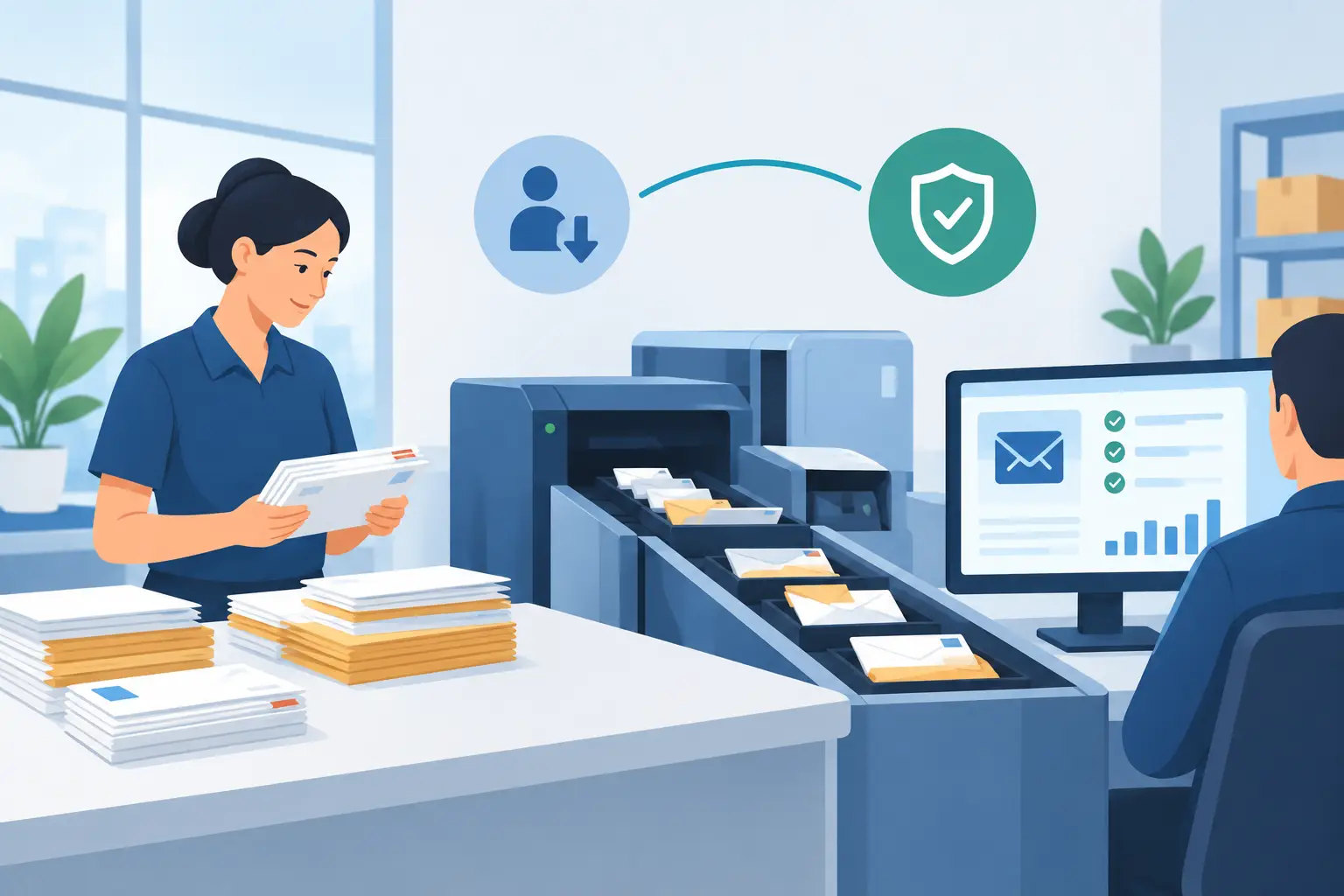
 A compliance notice rarely fails because someone forgot how to fold a letter. It fails when a deadline is missed, an address is entered incorrectly, USPS acceptance cannot be documented, or the organization cannot produce its mailing records when challenged. The goal to reduce mailroom labor should therefore never mean reducing control. It should mean removing repetitive handling while strengthening the evidence behind every critical mailing.
For law firms, property managers, utilities, collection agencies, insurers, and government offices, manual mail preparation consumes more than staff time. It introduces handoffs, creates inconsistent records, and leaves too much of a time-sensitive process dependent on one person getting every detail right. A better workflow shifts routine production away from the office while preserving visibility into what was mailed, when it entered the USPS system, and what happened next.
Where Mailroom Labor Actually Accumulates
Most organizations do not see the full labor cost of a mailing until they map the process from document approval through record retention. Printing is only one step. Staff may need to export data, prepare letters, check addresses, collate enclosures, fold documents, insert them into envelopes, apply postage, generate Certified Mail forms, collect receipts, travel to the post office, and file confirmations after delivery.
Each activity can appear minor on its own. Together, they create a labor-heavy process that becomes difficult to manage when notice volume rises or deadlines converge. A property management office sending lease notices, for example, may have to prepare dozens of individualized packages within a narrow statutory window. A legal team may need defensible proof that a demand letter was accepted by USPS on a particular date. In either case, the work is not merely administrative. It is part of the organization’s compliance posture.
The hidden burden continues after mail leaves the office. Someone must monitor tracking events, respond to delivery questions, retain mailing evidence, and locate records months or years later. If receipts are stored in paper files, email inboxes, or separate tracking spreadsheets, retrieving a complete mailing history can become another manual project.
Reduce Mailroom Labor by Removing Touchpoints
The most reliable way to reduce mailroom labor is to reduce the number of times a document and its data must be handled. Every manual touchpoint creates an opportunity for delay, mismatch, or incomplete documentation.
A centralized online mailing workflow allows authorized staff to upload a final PDF, submit recipient information, select the appropriate mailing service, and release the job for production. The platform prints, addresses, and presents the mailing to USPS. Rather than asking an internal employee to operate as a print shop, mail clerk, and records custodian, the organization keeps its team focused on approvals, exceptions, and customer-facing work.
This model is especially useful for Certified Mail and other formal correspondence because the operational record is tied to the job from the beginning. The mailing team does not need to separately match a paper receipt to a client file after a post office visit. Instead, mailing details, tracking activity, and available delivery confirmations can be retained with the submission record.
Outsourcing physical production does require a clear process. The document must be final before release, recipient data must be validated, and internal approval rules must be defined. Those are appropriate controls. They are materially different from requiring staff to spend hours assembling envelopes and waiting in line for acceptance scans.
Build a Workflow Around the Right Level of Proof
Not every document requires the same mail class or confirmation option. Trying to treat every notice identically can add cost and work without improving compliance. The right approach starts with the legal, contractual, or policy requirement attached to the correspondence.
Some notices require USPS Certified Mail because the sender needs documented acceptance, in-route tracking, and delivery information. Others may only require proof that the document was mailed on a specific date. For those situations, a Certificate of Mail or a First-Class compliance letter with documented USPS acceptance may be appropriate, depending on the governing requirement and organizational policy.
The distinction matters. Certified Mail can provide a stronger chain of documented events, while Return Receipt Signature confirmation may be necessary only when a signature is specifically required. Selecting services by document type prevents employees from making judgment calls at the mailroom counter and helps control unnecessary postage expense.
Create a documented mailing matrix for recurring correspondence. It should identify the document category, required mailing method, confirmation level, deadline rule, responsible approver, and retention period. This gives staff a repeatable decision framework and limits the need for case-by-case interpretation.
Standardize Inputs Before Production
Mailing automation works best when upstream documents and recipient data are consistent. A clean process may include approved letter templates, required naming conventions, standardized address fields, and a final review step before files are released.
That does not mean every document has to look the same. Legal notices often require individualized language, account details, or case-specific enclosures. The goal is to standardize the submission process around those variable documents. When staff know exactly where to upload a PDF, how recipient data should be formatted, and which service code applies, training is faster and exception rates decline.
Address quality deserves special attention. A platform can efficiently produce mail, but it cannot cure incomplete recipient information or an outdated address supplied by the sender. Establish a process to validate addresses at the source and flag records that need review before a deadline is at risk.
Use Automation for Volume, Not Just Convenience
Manual upload workflows can substantially reduce internal handling for lower or moderate volumes. Organizations with recurring, high-volume mail should also evaluate system-to-system automation through an API or SFTP workflow.
Automation can transmit approved PDFs and recipient data directly from a case management system, property management platform, billing system, or internal document workflow. This eliminates repeated data entry and reduces the risk that an employee will attach the wrong letter to the wrong recipient record. It also creates a more consistent production trail across departments or locations.
The trade-off is implementation effort. API and SFTP integrations require technical planning, field mapping, security review, testing, and procedures for failed submissions. For a team sending a few time-sensitive notices each month, a controlled online submission process may be the practical choice. For an enterprise team sending recurring batches, integration can remove thousands of repetitive actions over the course of a year.
The key question is not whether automation is sophisticated. It is whether it eliminates a documented source of delay or error. Start with the highest-volume, most repetitive notice types, then expand once the workflow is proven.
Keep Tracking and Records in the Same Operational View
A labor reduction project can create a new problem if staff must visit multiple systems to answer basic questions: Was the letter mailed? Was it accepted? What is the tracking number? Was delivery attempted? Where is the record?
Centralized tracking and reporting reduce these follow-up tasks. Authorized users should be able to locate a mailing by recipient, job, account, or tracking number and review the available USPS events without reconstructing the history from paper receipts. When a recipient disputes notice, the team can respond from a complete mailing record rather than searching storage cabinets or requesting evidence from several offices.
Long-term retention is equally important. Compliance mail is often questioned well after the original transaction. Retaining records for a defined period, including proof of mailing and delivery-related documentation where available, supports audit preparation and reduces the burden on staff who would otherwise maintain fragmented archives. Send Certified Mail, for example, retains mailing records for up to 10 years, giving organizations a durable reference point for audit-sensitive correspondence.
Measure the Results Beyond Headcount
A successful effort to reduce mailroom labor should not be measured only by fewer hours spent stuffing envelopes. Track outcomes that reflect process control: time from document approval to USPS acceptance, percentage of jobs released before deadline, address-related exceptions, number of manual data entries, tracking inquiry response time, and time required to retrieve a historical mailing record.
These measures reveal whether the new process is truly improving reliability. If production is faster but staff still spend hours reconciling tracking data, the workflow is incomplete. If records are retained but users cannot quickly search them, the operational benefit is limited. The best workflows reduce labor at every stage, from submission through retrieval.
Assign ownership as well. Compliance, operations, IT, and legal teams may each have a role, but one process owner should be accountable for service rules, exception handling, user access, and periodic review. A clear owner keeps the workflow from drifting back into email requests, local spreadsheets, and undocumented workarounds.
Make Mail an Exception-Based Process
The practical objective is not to eliminate human judgment from important correspondence. It is to reserve human effort for the decisions that require it: approving sensitive language, resolving bad addresses, handling deadline exceptions, and reviewing delivery issues. Printing, stuffing, labeling, post office trips, receipt filing, and routine tracking checks should not be the work that determines whether a compliance deadline is met.
When your mail process is built around controlled submission, appropriate USPS services, centralized evidence, and automation where volume justifies it, the mailroom becomes less of a bottleneck. Your team can spend less time producing mail and more time ensuring that every important notice is properly documented, defensible, and ready when it matters.